Beyond Pride: What Nivea and Barilla Reveal About LGBTQ+ Allyship in Business
After Pride Month fades, LGBT Wrath Month turns attention from visibility to accountability. This piece examines the backlash against Nivea following alleged anti-gay remarks, the role agencies play in pushing back on harmful views, and how brands like Barilla show that meaningful change is possible.
IMAGE GALLERY
Apple podcasts
Pride Is Over. Now What?
So June Pride Month is OVER and done with… but with all of the glitter and rainbow flags still littering the streets of Straight America, what happens next? Well, it’s July… so welcome to LGBT Wrath Month. With all of the support and solidarity our heterosexual, and corporate allies have shown this past Pride season, July Wrath Month isn’t about showing pride; it’s about acting on it. It’s a time for action against those organizations that have worked against our community: and one of those brands at the center of wrath this month is Nivea.
Why Nivea Is at the Center of LGBT Wrath Month
It’s the biggest and perhaps most notorious brand this wrath month. If you’re at all familiar with Nivea, it is a global skin care brand pulling in almost $5.2 BILLION as of May 2019, according to Forbes. Overall, Forbes values the brand at over $8 BILLION… that’s a pretty big bag. Chances are, you or someone you know has used or purchased a Nivea product, as their assortment ranges from body wash, to lip balm, to facial cleansers, and they have distribution in the US, Central America, Europe, Asia… pretty much everywhere. With such deep pockets and far-reaching influence around the world… it’s a bit disheartening when you learn that top Nivea employees claim “We don’t do gay.”
The Allegations: “We Don’t Do Gay”
This is a quote from several news sites, most notably Ag Age, Forbes, and Newsweek. Originally reported by Ad Age, authors Lindsay Rittenhouse and Jack Neff write “[Nivea] rejected an image that [FCB] pitched showing two men’s hands touching,” and that a member of the client team allegedly remarked that “we don’t do gay at Nivea.”
What We Know (and What We Don’t)
Now, before we break out the pitchforks and start lighting up the torches, let me try to be a little unbiased here. FCB has currently declined to comment on the situation, but Ad Age did report that the agency has circulated a memo stating that FCB will be severing ties with Nivea next April – after over 100 years. Chances are there are other things at work in the background, as FCB has declined to comment on the anti-gay allegations which still remain unconfirmed.
Nivea’s parent company, Beiersdorf, which is a German-based host of consumer brands, put out a response that, despite not directly addressing the anti-gay allegations, iterated that Beiersdorf is about diversity. In a statement to Yahoo Finance, Beiersdorf shared:
“We understand that emotions and news interest are intensified when a longtime business relationship comes to an end. However, we ask for understanding that we don’t comment on unsubstantiated speculations around this matter.”
This is in reference to the severed relationship with FCB, which some argue was because of the anti-gay remarks. The spokesperson went on to say “Nonetheless we wish to express our concern on the reported allegations as they do not reflect the values of Beiersdorf, Nivea and our employees worldwide. No form of discrimination, direct and indirect, is or will be tolerated. We are strongly committed to diversity, mutual respect, equal opportunity and tolerance - this stance and belief is shared and lived throughout Beiersdorf.”
Public Backlash and Queer Consumer Response
Now, as compelling as some of those words may be… I like a few others online, still remain unconvinced. Doing a quick search for conversations around Nivea and the anti-gay allegations, a few members of the LGBTQIA+ are already showing their wrath on Twitter. Users have taken to hashtagging things like “#IDontDoNivea” and attaching photos of their Nivea products in the trash. One of the most notable users chiming in on this was Perez Hilton. Tweeting from his personal account on July 4th he wrote “I don’t do #nivea!” and attached a link to the Newsweek article.
Is there a Responsibility to Push Back?
Now, I’d like to pivot from this just a bit and dive into some discussion surrounding Nivea and FCB, and the role of agencies in this kind of a situation. A great question posed by Imogen Watson from The Drum, which is a European-based marketing magazine, asked “Do ad agencies have a responsibility to react against controversial client views?” I think this is the right question to ask, and I personally think the answer is YES. Watson cites a quote from Jan Gooding, who is the chairman of the Stonewall LGBT charity stating “Words have consequences, particularly in the workplace.” -- And I think that’s just it!
To all of those contrarians saying FCB should “stay in its lane,” and “avoid getting political” with LGBT stances, or perhaps saying that “sexuality shouldn’t come into the discussion” in business – I say this: the very core of any functional business relationship is just that: the relationship. If you’ve got a business partner or client that fundamentally disagrees with your very existence – I don’t think anyone in their right mind would ascertain that this relationship will be profitable or lasting.
“Can’t We Just Keep Sexuality Out of Work?”
A counterpoint someone might have is: Well, why does something like sexuality need to come up at all? Can’t everyone just do their jobs and go home?
Well, in a perfect world, yes. And if you’re more than happy to work in a cold, unfeeling, and transaction-oriented office environment where the only discussions that occur are business ones, then sure! Sexuality doesn’t need to come up. But businesses are run by people: and people have children, and weekend barbeques, and vacation plans – all things that get mentioned in any civil office place at some point or another.
It is thereby impossible for people on the LGBTQIA+ spectrum to comfortably avoid these kinds of subjects when you’re standing at the water cooler, or heading to the office happy hour – and to make my point clear, they shouldn’t HAVE to avoid these conversations. As such, I’d say that agencies in a situation like FCB have no choice but to address controversial views such as Nivea’s “we don’t do gay.” To start: some sources reported that the FCB agency team even had an LGBT person on the call when the Nivea employee made that remark. That’s pretty hard to ignore.
Accountability Without Mob Mentality
However, I in no way want to sound like I am advocating for mob mentality when it comes to business controversies such as this. I think that the actions of a single employee don’t necessarily reflect the views of an organization at large – especially not for a global brand like Nivea. I would hope there are plenty of queer people at Nivea making waves internally, promoting diversity, inclusion, and queer advocacy in the workplace. This is why I agree with another quote from Jan Gooding provided by The Drum’s article, stating “to be fair, we can all make mistakes or say the wrong thing out of ignorance. I would always suggest exploring routes of education, apology, and take the opportunity to put things right as a first move.” It’s for this reason I think we should focus on the people in the situation. Is there a people-culture at Nivea? Are these types of comments typical from management or even executive leaders? The problem will almost always be the people, but they can also be the solution.
A Case Study in Doing the Work: Barilla’s Turnaround
Take Barilla, for example. This is the pasta company you’ve probably heard of or eaten at some point or another. Back in 2013 there was a huge anti-LGBT scandal when the company’s chairman, Guido Barilla, went on a radio interview and stated “I would never do (a commercial) with a homosexual family, not for lack of respect but because we don’t agree with them. Ours is a classic family where the woman plays a fundamental role.” When asked if he would be concerned with LGBT people not buying his pasta he stated if gays “like our pasta and our advertising, they’ll eat our pasta. If they don’t like it, then they will not eat it and they will eat another brand.”
These statements sparked almost an immediate backlash with consumers all over the world boycotting the brand, and hashtagging #BoycottBarilla. Some consumers even called for retailers to pull the brand off the shelves, garnering tens of thousands of petition signatures online. Even organizations like GLAAD and the Human Rights Campaign condemned Barilla for the Chairman’s statements, rallying behind some petitions, and even publishing lists of alternative, LGBT-friendly brands to buy.
You’d think Barilla would have made its bed with the organization’s most visible and arguably most influential figure, Guido Barilla, making such sweeping statements. However, Barilla quickly turned things around following the backlash. Just a couple of month’s after Guido Barilla’s remarks, the organization announced it would be installing a new diversity and inclusion board to help make it a more welcoming company to work for. Not only that, but this board actually had a tangible effect on the brand, as just ONE year later in 2014, the Human Rights Campaign which initially condemned the brand, had ranked them at 100% on the Corporate Equality Index. Meaning the organization was making REAL changes to welcome the LGBTQIA+ community with internal policy and external community engagement.
Barilla has even maintained these high LGBTQIA+ equality scores since then. This just goes to show how, even in a situation like that with Nivea, there is always a way back – a way to make amends and do right. For example: as recently as 2018, Barilla has shown continued support for the LGBTQIA+ community, with the best example being their limited-edition Spaghetti No 5 pasta boxes featuring two women sharing spaghetti, Lady-and-the-Tramp style.
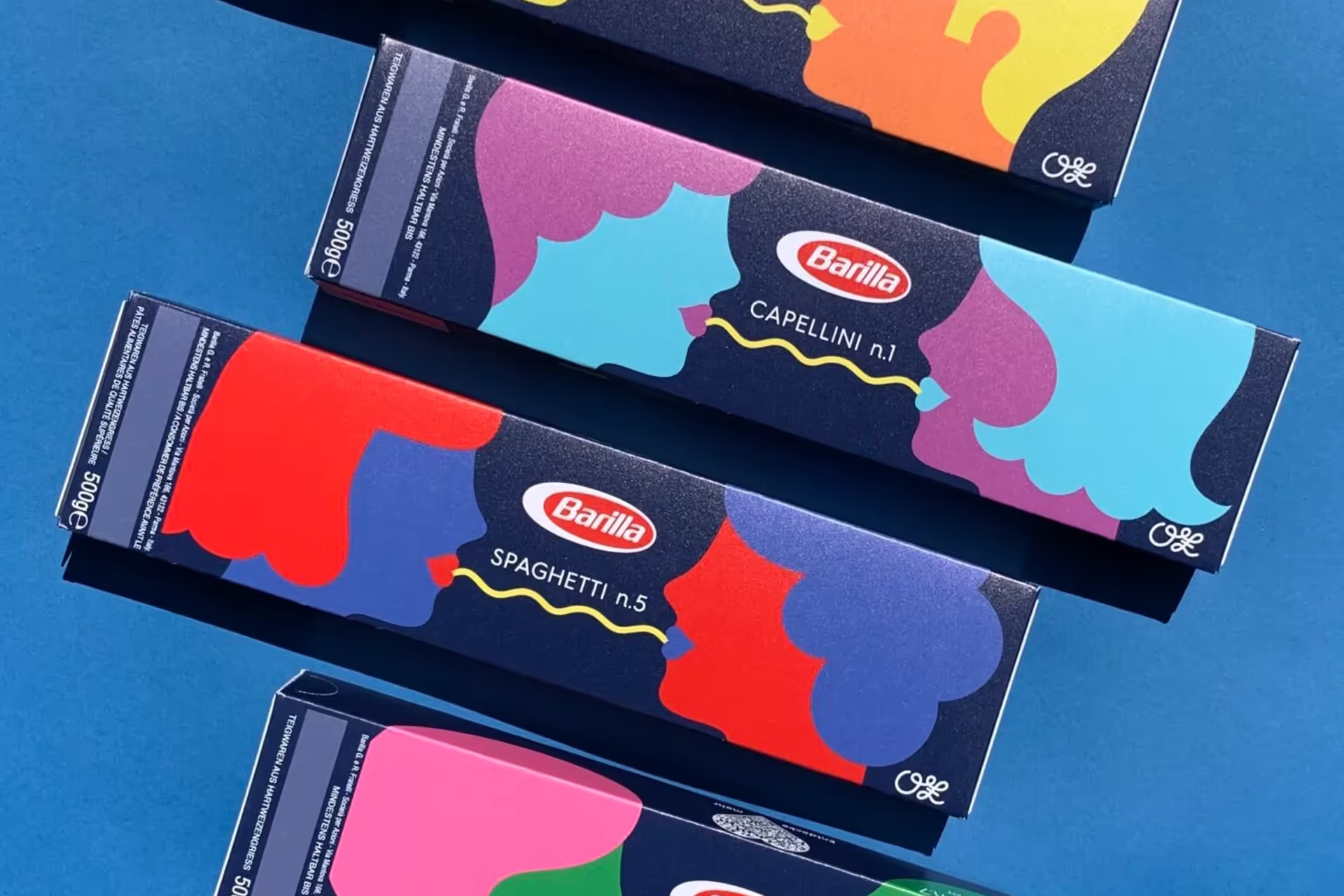
It was designed by Olimpia Zagnoli, and LGBT Nation cites her as initially thinking Barilla would reject the design, but was surprised to learn they accepted it. These boxes premiered at the Pasta World Championship in 2018 and were given out at the event in Milan. This is a prime example of Barilla’s continued support and 180-turnaround from their views in 2013 – promoting LGBTQIA+ acceptance and love on their own turf, as Barilla is a brand found in nearly every Italian grocery. This was most definitely a huge win for our community, and a win for Barilla in terms of doing right.
Wrath Month Is About Change, Not Cancellation
So as the rest of LGBT wrath month trickles in, let’s make sure to keep using our voices as a community to not just “cancel” or “shade” brands for their views. Instead, let’s use our voices as a conduit of change – as with brands like Nivea, change might still be on the horizon, and it’s through advocacy and never-shutting-up that we can make great things happen. More so, it’s through fighting the good fight, internally, at your organization, that change can really be affected.